Teachings
A teaching that speaks from the śāstras to the present
The foundation is Advaita Vedanta. From it, the Shankaracharya addresses a wide range of subjects — ethics, science, society and the nation — always reasoning from the scriptures rather than around them.
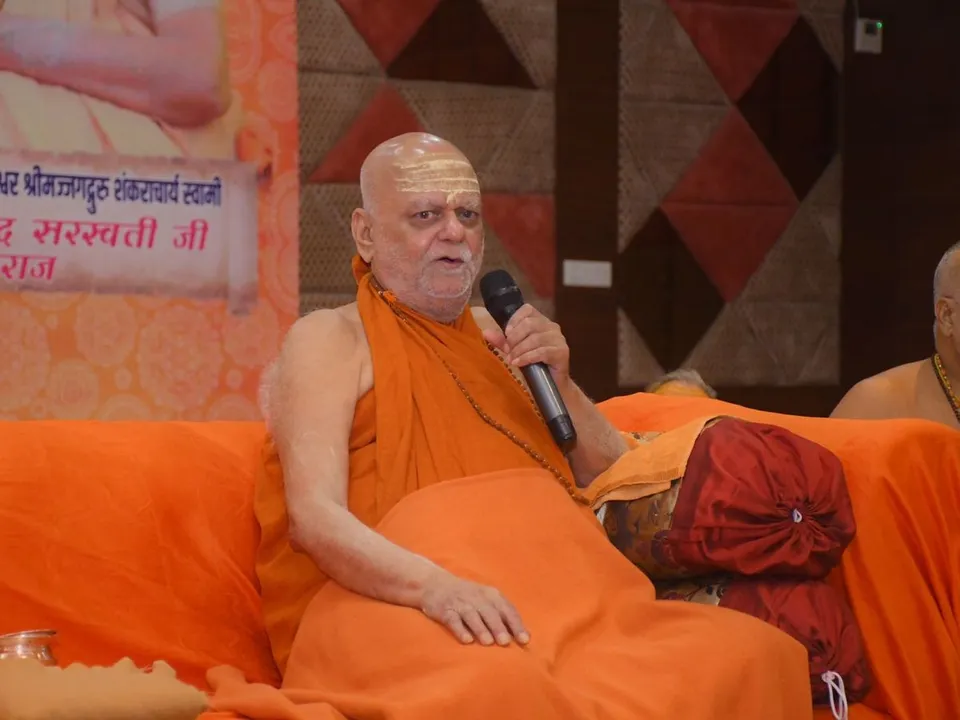
How these themes were compiled
The themes below are drawn from the Peetha’s own description of his work, from the aims of the organisations founded under his guidance, and from the titles and subjects of his published books. They are summaries written for a general reader, not quotations. For his words in his own voice, consult his books and the recorded discourses on the Peetha’s official channels.
The foundation in Vedanta
Everything a Shankaracharya teaches rests on the Advaita Vedanta of Adi Shankara: the identity of the Self and Brahman, the authority of the Upaniṣads, and the necessity of discipline and knowledge for liberation. Swami Nishchalananda Saraswati’s own formation — years devoted to the Prasthānatrayī, the Pañcadaśī and the dialectical Khaṇḍanakhaṇḍakhādya — reflects a teacher trained to defend this position in argument as well as to expound it.
His bibliography includes works of classical Vedanta, such as a treatise titled Śārīraka Svārājyasiddhi, alongside writings on the governance of the maṭhas themselves. The Philosophy page introduces the core ideas on which all the other themes depend.
Sanatana Dharma as principle
Sanātana Dharma — “the eternal order” — is the tradition’s own name for what is commonly called Hinduism. A recurring emphasis of the Shankaracharya is that it should be understood as a coherent set of principles, not merely a collection of customs: a framework grounded in the Veda, reasoned out through the classical philosophical schools, and applicable to every sphere of life.
The title of one of his books, Sukhamaya Jīvana kā Sanātana Siddhānta (“The Eternal Principle of a Happy Life”), captures the practical bent of this approach. The Sanatana Sant Samiti, one of the bodies associated with the Peetha, describes its purpose as presenting Vedic philosophy on philosophical, scientific and practical grounds.
Scripture, science & mathematics
Among contemporary religious leaders, the Shankaracharya is unusual in the attention he has given to mathematics. Several of his works — Svastika Gaṇita, Gaṇitāditya and Gaṇita Darśana (“The Philosophy of Mathematics”) — are devoted to it. Svastika Gaṇita and Gaṇitāditya are published in Sanskrit with Hindi translation by Swasti Prakashan Sansthan, Puri.
This interest has a local history. Swami Bharati Krishna Tirtha, Shankaracharya of Puri from 1925 to 1960, is widely known for Vedic Mathematics, a book of rapid calculation techniques published in 1965. The claim that such techniques derive from Vedic sources has been debated by historians of mathematics; the work’s popularity as a method of mental calculation is not in dispute. The present Shankaracharya’s writings extend the broader conviction that the śāstras and rigorous scientific reasoning are not opposed.
Ethics and statecraft
Nīti is the Sanskrit tradition of practical ethics and political wisdom — how individuals should conduct themselves and how societies should be governed. It is one of the most prominent subjects in the Shankaracharya’s bibliography, which includes Nīti Nidhi, Nīti Sāvitrī, Nīti Cālīsā and Nīti aur Adhyātma (“Ethics and Spirituality”).
The last title signals the connecting thread: ethical and political order is treated not as a separate domain from spiritual life but as its foundation. The ideal of a polity guided by dharma — often expressed in the tradition through the image of Rāma-rājya, the just kingdom of Rama — appears in the stated aims of organisations the Peetha lists, such as the Ramrajya Parishad.
The unity of India
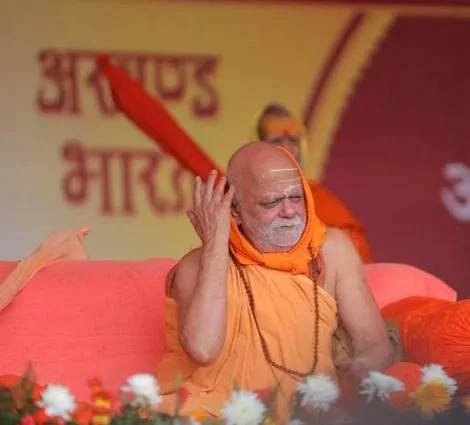
The Peetha’s biography names “the unity of India” and “the protection of its territories” first among the subjects of his tours. The theme draws on a traditional understanding of India as a sacred geography — bound together by pilgrimage routes, by the four dhāmas at its cardinal points, and by the four cardinal seats of the Shankara tradition itself.
The Rashtrotkarsh Abhiyan, a “campaign for the upliftment of the nation” listed by the Peetha, pairs this cultural vision with practical aims in agriculture, commerce and cottage industries.
Cow protection & rural life
Cow protection has been part of the Shankaracharya’s public life for six decades. As a young man he joined the cow-protection movement led in part by his guru, Swami Karpatri, and was held in Tihar jail for 52 days from 9 November 1966.
Today the Peetha maintains the Shree Govardhan Goshala, a sanctuary for cows. In the tradition’s understanding the cow is not only revered but central to a rural economy of agriculture and household self-reliance — a link reflected in the stated agricultural aims of the Rashtrotkarsh Abhiyan.
Women, family & youth
The Peetha lists “women empowerment” among the subjects of his public work. Two organisations founded under his guidance give this concern institutional form. Ananda Vahini, for women and girls, aims at “a society and healthy family that is well-educated, well-cultured”. Aditya Vahini, for men and boys, promotes service grounded in fearlessness, good conduct and radiance of character.
The family is treated as the first school of dharma — the place where values, culture and learning pass from one generation to the next.
Care for the environment
Environmental protection is also named in the Peetha’s account of his tours. Within the Vedic worldview, rivers, mountains, forests and the earth itself are honoured as sacred, and the order of nature (ṛta) is inseparable from the moral order (dharma). Care for the environment is therefore presented not as a modern add-on but as an expression of an old reverence.
Hindu identity & public life
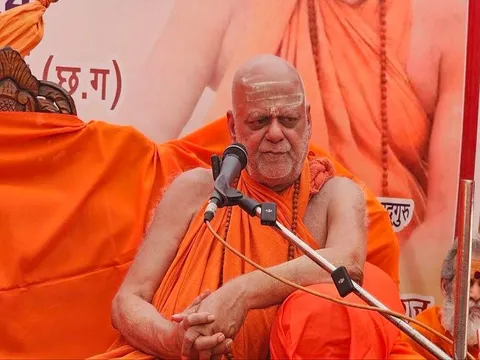
The Shankaracharya is an outspoken advocate of Hindu identity and of public life guided by dharma. One of his books is titled Garva se Kaheṃ — “Ham Hindū Haiṃ” (“Say with Pride — ‘We Are Hindus’”), and the Peetha lists a Hindu Rashtra Sangh among its associated bodies, with the stated aim of protecting “the existence and values of Hindus with due regards to other’s welfare”.
His positions on public questions are frequently reported in the press and are part of wider debate in Indian public life. This website does not attempt to summarise individual statements; readers are encouraged to consult his books and full recorded discourses, which place them in the context of the scriptural reasoning from which they arise.
Continue to Discourses to learn how these teachings are delivered, or to Writings & Publications for the books themselves.