Biography
A scholar-monk of the Shankara tradition
From a household of Sanskrit learning in Mithila to the eastern seat of Adi Shankaracharya at Puri.
Swami Nishchalananda Saraswati was born Nilambar Jha on 30 June 1943. Renouncing household life in 1974, he was appointed the 145th Jagadguru Shankaracharya of the Purvamnaya Sri Govardhana Peetha on 9 February 1992.
01 · Introduction
Who is Nishchalananda Saraswati?
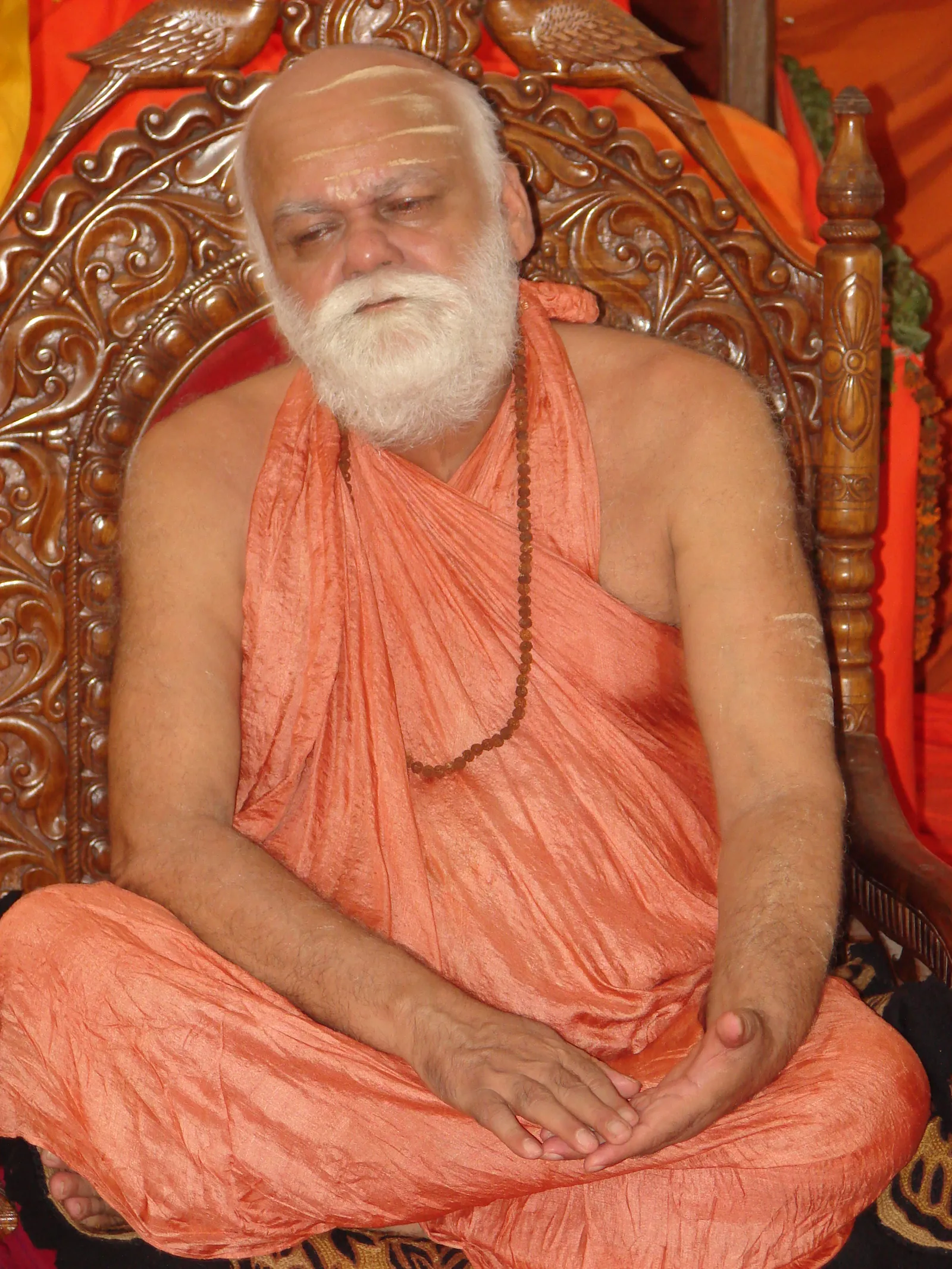
Jagadguru Shankaracharya Swami Nishchalananda Saraswati is the head of the Govardhana Peetha (Govardhan Math) in Puri, Odisha — one of the four cardinal monasteries that the Shankara tradition traces to Adi Shankaracharya. In the counting kept by the Peetha, he is the 145th teacher to occupy its seat.
The title Jagadguru means “teacher of the world”; Shankaracharya identifies the holder as a successor of Adi Shankara in one of the cardinal seats. Together they describe an office rather than a personal honour: the Shankaracharya is expected to embody the renunciate life, to preserve the teaching of Advaita Vedanta, and to offer guidance on dharma to those who seek it.
His own path to that office was long and deliberately scholarly. Before his appointment he spent nearly two decades as a monk in the study of Vedanta and allied disciplines under recognised teachers, and he has continued to write and teach extensively since. He is known in particular for works in Hindi and Sanskrit on Vedanta, on ethics (nīti), and on mathematics as understood within the Vedic tradition.
02 · Life & Background
A childhood among Sanskrit scholars
Nilambar Jha was born on 30 June 1943 in the village of Haripur Bakshi Tol in the Madhubani district of Bihar — the heart of Mithila, a region with a centuries-old reputation for Sanskrit learning, particularly in logic (nyāya) and ritual exegesis (mīmāṃsā).
His father, Pandit Lalvamshi Jha, was a Sanskrit scholar who served as a court pandit to the Maharaja of Darbhanga, the historic ruling house of Mithila; his mother was Smt. Gita Devi. According to the Peetha’s biography, the name Nilambar was given to him by his elder brother, Pandit Sridev Jha.
He received his early schooling in the villages of Kaluahi and Loha, and continued his education in Delhi, where he studied at the Tibbia College.
The biography describes him as a studious and disciplined child. At the age of seventeen he left home to pursue spiritual study — a decision that would take him through many of India’s great centres of traditional learning.
03 · Spiritual Journey
From Dhruvachaitanya to Nishchalananda
The young seeker found his principal teacher in Swami Karpatri (1907–1982), one of the most influential traditionalist scholars and monks of twentieth-century India and the founder of several religious and public organisations. As a celibate student (brahmacārī) he received the name Dhruvachaitanya from Swami Naradanand Saraswati of Naimisharanya.
His studies took him to Kashi (Varanasi), Vrindavan, Naimisharanya, Badrikashram, Rishikesh, Haridwar, Puri and Sringeri — a pilgrimage of learning that crossed the length of the subcontinent and included Puri and Sringeri, home to two of the four cardinal seats of the Shankara tradition.
- 1943
Birth in Mithila
Born 30 June at Haripur Bakshi Tol, Madhubani, into the family of Pandit Lalvamshi Jha and Smt. Gita Devi.
- Age 17
Leaves home for study
Begins a life devoted to the śāstras; accepts Swami Karpatri as his spiritual master and is named Dhruvachaitanya as a brahmacārī.
- 1966
Cow-protection movement
Takes part in the cow-protection campaign; from 9 November 1966 he is held in Delhi’s Tihar jail for 52 days.
- 1974
Sannyasa at Haridwar
On 18 April 1974 (Vaiśākha Kṛṣṇa Ekādaśī) he receives monastic initiation from Swami Karpatri and the name Nishchalananda Saraswati.
- 1976–81
Vedanta in depth
Studies the Prasthānatrayī — the Upaniṣads, the Bhagavad Gītā and the Brahma Sūtras — together with the Pañcadaśī and related works.
- 1982–87
With Niranjanadeva Tirtha
Studies the Khaṇḍanakhaṇḍakhādya and the Yajurveda under the Shankaracharya of Puri, spending five cāturmāsya retreats with him.
- 1992
145th Shankaracharya
Appointed to the Govardhana Peetha on 9 February 1992 by Swami Niranjanadeva Tirtha.
Two terms in this chronology deserve explanation. The Pañcadaśī is a fourteenth-century manual of Advaita attributed to Vidyaranya, prized for its systematic exposition. The Khaṇḍanakhaṇḍakhādya, by the twelfth-century poet-philosopher Śrīharṣa, is a famously demanding work of dialectic that defends non-dualism by dismantling the definitions of rival schools. A cāturmāsya is the four-month monsoon period during which renunciants traditionally remain in one place, devoting themselves to study and teaching.
The Peetha’s biography situates his appointment at the end of a long apprenticeship — study first, office later.
04 · The Shankaracharya Tradition
What it means to be a Shankaracharya
Adi Shankaracharya is remembered as the great systematiser of Advaita Vedanta. His commentaries on the Upaniṣads, the Bhagavad Gītā and the Brahma Sūtras became the classical statement of non-dualism. The tradition also credits him with organising the Dashanami order of renunciants and establishing four principal maṭhas — at Sringeri in the south, Dwarka in the west, Jyotirmath in the north and Puri in the east — each presided over by one of his disciples.
The heads of these seats came to bear the title Shankaracharya. Each seat is associated with one of the four Vedas and one of the four mahāvākyas, the “great statements” of the Upaniṣads that express the identity of the individual Self with Brahman.
A Shankaracharya is at once a monk, a scholar and the steward of an institution. The office carries responsibility for the monastery and its disciplines, for teaching and interpreting the scriptures, and for guiding the community on questions of dharma. Succession traditionally passes from a presiding teacher to a chosen disciple, following norms that the tradition preserves in texts on monastic governance.
Modern historians generally place Shankara in about the eighth century CE and study the institutional history of the maṭhas through inscriptions and records; the maṭhas themselves preserve their own traditional chronologies. This website distinguishes the two where it matters. See Tradition & Lineage for a fuller account.
05 · Jagadguru of Govardhana Peetha
Three decades at the eastern seat
Since 1992 Swami Nishchalananda Saraswati has led the Govardhana Peetha, whose tradition traces its first ācārya to Padmapāda, a direct disciple of Shankara. The seat’s sacred associations are the Ṛgveda, Lord Jagannatha of Puri and the mahāvākya Prajñānaṃ Brahma — “Consciousness is Brahman.”
Under his guidance the Peetha has established or associated itself with a family of organisations, including the Peetha Parishad, Aditya Vahini (for men and youth) and Ananda Vahini (for women and girls). The Peetha describes his travels as addressing the unity of India and the protection of its territory, cow protection, the empowerment of women and the protection of the environment.
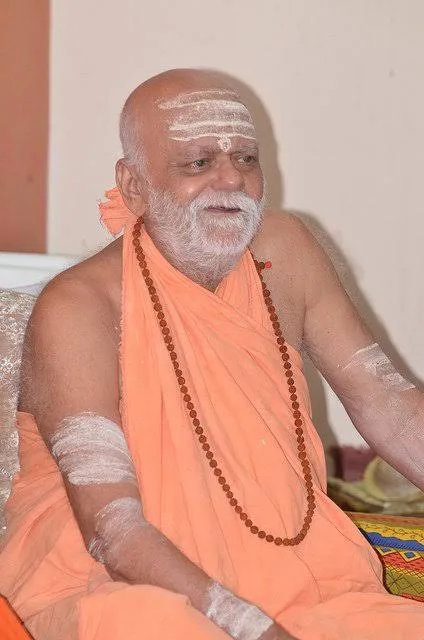
The Peetha’s silver jubilee under his leadership was marked in Puri in February 2018. Alongside administrative responsibility, he has continued a steady output of books and discourses in Hindi and Sanskrit — on Vedanta, on ethics and governance, and on mathematics, a field with a notable history at this Peetha through an earlier Shankaracharya of Puri, Swami Bharati Krishna Tirtha (1925–1960).
Continue to the history of the Govardhana Peetha, read about his teachings, or explore his writings and publications.