Govardhana Peetha
Puri, Odisha- First ācārya
- Padmapāda
- Veda
- Ṛgveda
- Mahāvākya
- Prajñānaṃ Brahma
Tradition & Lineage
A Shankaracharya does not teach in his own name. He speaks as the latest link in a chain of teachers — a paramparā — that the tradition traces back to Adi Shankaracharya and, beyond him, to the Upaniṣadic sages.
Adi Shankaracharya
Adi Shankaracharya is the towering figure of Advaita Vedanta. His commentaries established the interpretive framework within which the school has worked ever since. The account of his life below follows the traditional biographies known as the Śaṅkara-vijaya (“Shankara’s victory”) texts, which are works of sacred biography composed centuries after him.
Tradition holds that Shankara was born into a Brahmin family at Kaladi, on the banks of the Periyar river in present-day Kerala.
Taking sannyasa as a child, he travelled north and became the disciple of Govindapāda on the banks of the Narmada, receiving instruction in Advaita.
He composed commentaries on the principal Upaniṣads, the Bhagavad Gītā and the Brahma Sūtras — works whose authenticity is broadly accepted by modern scholars.
The biographies describe him travelling throughout the subcontinent, engaging scholars of rival schools in debate — most famously the ritualist Maṇḍana Miśra.
He is credited with organising the Dashanami order and establishing four cardinal maṭhas, each entrusted to a leading disciple.
Most modern historians place Shankara around the late seventh to eighth century CE. The maṭhas preserve older traditional chronologies; the Govardhana Peetha’s own account places its foundation many centuries earlier.
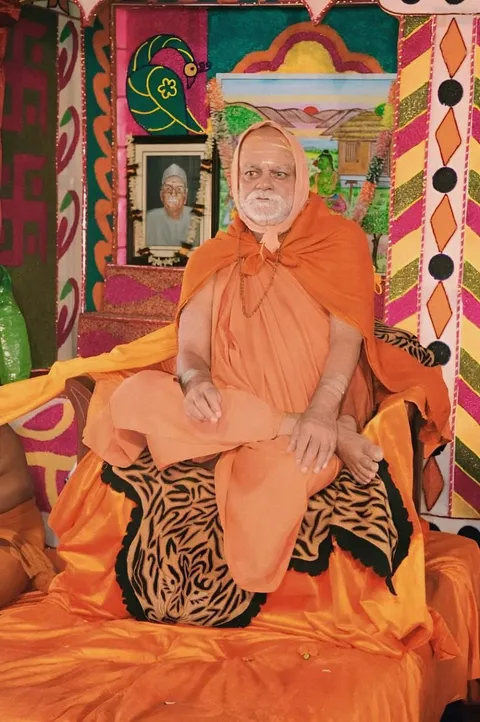
The Dashanami Order
The Daśanāmī Sampradāya — “the tradition of ten names” — is the order of renunciant monks associated with Shankara. On taking sannyasa, a monk receives one of ten suffixes, each connected with one of the four cardinal seats. The present Shankaracharya of Puri, for example, bears the name Saraswati, received from his guru Swami Karpatri at his initiation in 1974.
Associations follow the commonly cited traditional scheme; individual sources vary in detail.
The Four Cardinal Maṭhas
The four seats (āmnāya pīṭhas) are each linked with a direction, a Veda, a great Upaniṣadic statement and a first ācārya drawn from Shankara’s disciples.
Other monastic institutions, notably at Kanchipuram, also trace their origins to Adi Shankara. This page follows the four-seat scheme traditionally upheld by the Govardhana Peetha. The meaning of each mahāvākya is explained on the Philosophy page.
Succession & Role
Succession in the cardinal seats is, by tradition, a matter of the guru’s choice. A presiding Shankaracharya selects and prepares a qualified disciple — a renunciant learned in the scriptures and steady in discipline — and designates him as successor. The norms governing the seats are preserved in a traditional text on monastic governance known as the Maṭhāmnāya or Mahānuśāsana, on which the present Shankaracharya has himself written.
The Govardhana Peetha’s own recent history illustrates the pattern. Swami Nishchalananda Saraswati spent five cāturmāsya retreats studying under Swami Niranjanadeva Tirtha between 1982 and 1987, and was appointed by him as the 145th Shankaracharya on 9 February 1992.
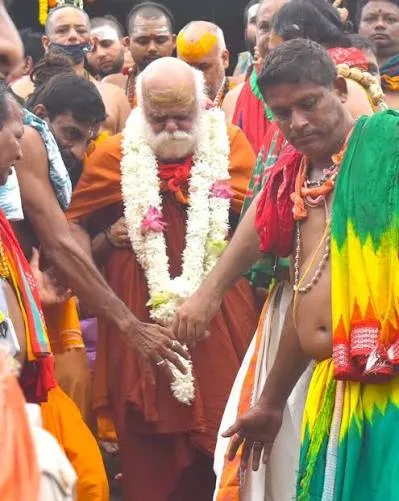
Tradition & History
The maṭhas preserve lists of their ācāryas reaching back to Shankara’s own disciples, and chronologies that place Shankara well before the Common Era. For the tradition, the continuity of the lineage is a sacred reality, sustained by the transmission of teaching and authority from guru to disciple.
Modern scholarship generally dates Shankara to about the eighth century CE, and studies the development of the maṭhas and the Dashanami order through inscriptions, manuscripts and later records. Some aspects of the traditional account — such as the precise founding of all four seats by Shankara himself — are treated by historians as questions for evidence.
This website presents both perspectives side by side, without using either to diminish the other. For the present-day seat at Puri, see Govardhana Peetha; for the life of its current head, see About.