Writings & Publications
A library in Hindi and Sanskrit
Alongside his discourses, the Shankaracharya has produced a substantial body of written work — on Vedanta, ethics, mathematics and the principles of Sanatana Dharma — most of it in Hindi, and some in Sanskrit with Hindi translation.
Textual Scholarship
Why a Shankaracharya writes
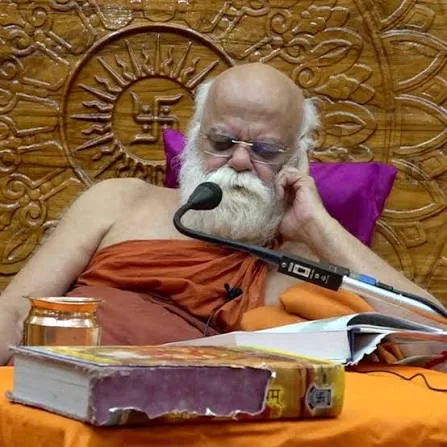
The Shankara tradition is, at its heart, a tradition of texts and commentaries. Adi Shankara taught largely through bhāṣya — commentary on scripture — and his successors extended that work in sub-commentaries, manuals and independent treatises. For a Shankaracharya, writing is not a sideline to spiritual office but one of its oldest duties: to state the teaching precisely, to defend it in argument, and to apply it to the questions of one’s own age.
Swami Nishchalananda Saraswati’s books stand in that line while ranging beyond classical Vedanta into ethics, statecraft, astronomy-astrology (jyotiṣa) and mathematics. Published counts of his works vary considerably between sources, so none is given here. The titles below are a selection whose authorship and subject can be confirmed from the listings of the Puri publisher Swasti Prakashan Sansthan and of established booksellers.
Selected works
Titles are given in Devanagari, followed by a transliteration and an English rendering of the title’s meaning. English renderings are descriptive translations, not published English titles.
Mathematics & Jyotiṣa
Works exploring mathematics and astronomical science from within the Sanskrit tradition.
- स्वस्तिक गणितSvastika Gaṇita
A work on mathematics, in Sanskrit with Hindi translation.
- गणितादित्यGaṇitāditya
“The Sun of Mathematics” — a mathematical treatise in Sanskrit with Hindi translation.
- गणितदर्शनGaṇita Darśana
“The Philosophy of Mathematics” — mathematics considered as a way of understanding reality.
- ज्योतिष दर्शनJyotiṣa Darśana
“The Philosophy of Jyotiṣa” — on the Vedic science of astronomy and time.
- अक्षरागमाङ्कमालिकाAkṣarāgamāṅkamālikā
A “garland” whose title joins letters (akṣara), scripture (āgama) and numbers (aṅka).
Nīti — ethics & statecraft
Practical wisdom for individuals, families and those who govern.
- नीतिनिधिNīti Nidhi
“A Treasury of Ethics.”
- नीतिसावित्रीNīti Sāvitrī
A work on ethical and political wisdom.
- नीतिचालीसाNīti Cālīsā
Ethical teaching in forty verses, after the popular cālīsā form.
- नीति और अध्यात्मNīti aur Adhyātma
“Ethics and Spirituality” — on the relation between right conduct and inner life.
Vedanta & the maṭha tradition
Classical philosophy and the governance of Shankara’s monasteries.
- शारीरक स्वाराज्यसिद्धिŚārīraka Svārājyasiddhi — Sārasamākhyā
A work in the Śārīraka tradition — the name given to Shankara’s commentary on the Brahma Sūtras.
- गुरुवंश-मठाम्नाय-दिग्दर्शन-सेतु-महानुशासनम्Guruvaṃśa-Maṭhāmnāya-Digdarśana-Setu-Mahānuśāsanam
On the lineage of teachers, the traditions of the four maṭhas and the Mahānuśāsana, the discipline governing the Shankaracharya seats.
Dharma & society
Sanatana Dharma in personal and public life.
- सुखमय जीवन का सनातन सिद्धान्तSukhamaya Jīvana kā Sanātana Siddhānta
“The Eternal Principle of a Happy Life.”
- गर्व से कहें — ‘हम हिन्दू हैं’Garva se Kaheṃ — “Ham Hindū Haiṃ”
“Say with Pride — ‘We Are Hindus’.” On Hindu identity as described in the śāstras.
Publication details beyond those shown could not be independently confirmed and are therefore omitted. For the complete catalogue and availability, contact Govardhan Math, Puri, through its official website.
The Classical Library
The texts behind the books
According to the Peetha’s biography, his years of monastic study centred on these works. They are the foundations on which his own writing is built.
Prasthānatrayī
The three canonical sources of Vedanta — the Upaniṣads, the Bhagavad Gītā and the Brahma Sūtras — studied with Shankara’s commentaries. Studied between 1976 and 1981.
Pañcadaśī
A fourteenth-century manual of Advaita in fifteen chapters, attributed to Vidyaranya, valued for its clear, systematic exposition of the teaching.
Khaṇḍanakhaṇḍakhādya
Śrīharṣa’s twelfth-century masterpiece of dialectic, studied with Swami Niranjanadeva Tirtha between 1982 and 1987 alongside the Yajurveda.
Old Learning, New Tools
The scholar’s desk today
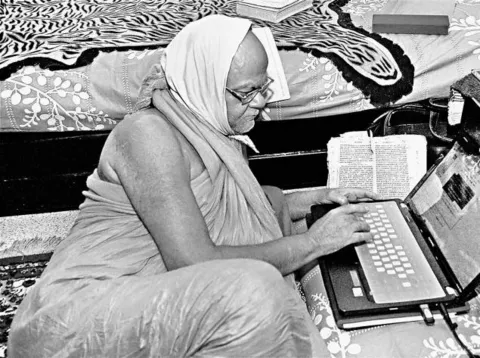
The image of a Shankaracharya at a laptop may surprise those who picture traditional learning as frozen in time. Yet the Shankara tradition has always adopted the tools of its age — from palm-leaf manuscripts to printed books to recorded and broadcast discourse.
What remains constant is the method: a text read closely, a teaching tested by reason, and a conclusion stated clearly enough to be examined by others. Explore the ideas behind these books in Philosophy and Teachings.