Discourses

The spoken word of the tradition

Before it was ever written down, Vedanta was taught aloud — teacher to student, verse by verse. The pravacana, or discourse, remains the Shankaracharya’s primary means of teaching, whether seated before a handful of students or addressing thousands.

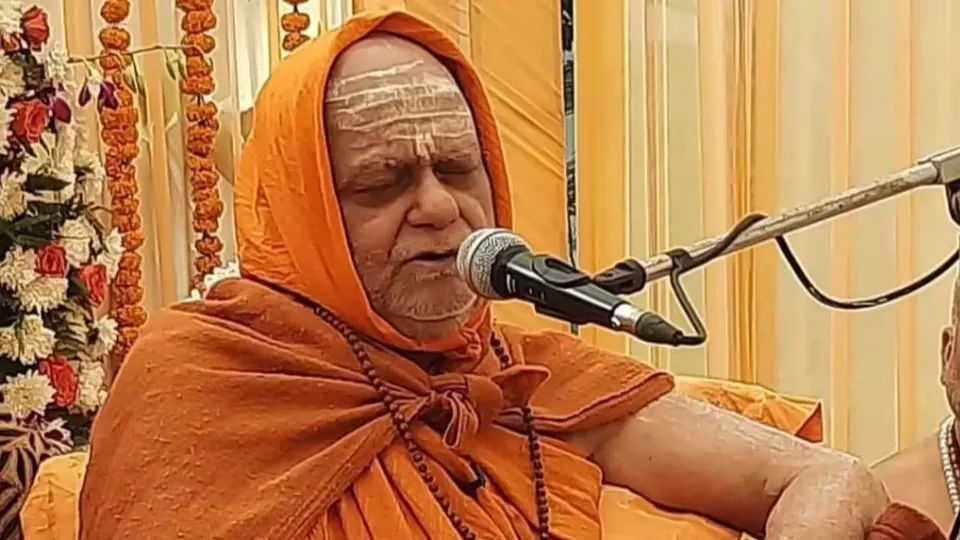
Nishchalananda Saraswati, head covered with a saffron cloth, speaking into a microphone during a discourse, with floral decorations behind him
Delivering a discourse. Recorded discourses are published on the Peetha’s official channels.

Forms of Teaching

Six settings in which the teaching is given

A catalogue of the settings in which a Shankaracharya teaches — each with its own purpose, audience and conventions. The notes on the right indicate what is publicly documented of the present Shankaracharya’s work in that setting.

प्रवचन

Pravacana — scriptural discourse

The classical form: a sustained exposition of a text such as an Upaniṣad or the Bhagavad Gītā, moving from the Sanskrit verse to its meaning, the commentaries and their implications for life. Discourses often continue over several days, building an argument session by session.
धर्मसभा

Dharma-sabhā — public assembly

Large gatherings at which the Shankaracharya addresses a broad public on questions of dharma and contemporary life. These assemblies connect the maṭha with communities far from Puri and are traditionally occasions for blessing and guidance as well as instruction.

यात्रा

Yātrā — teaching tours

Shankara himself is remembered as a traveller who taught across India. His successors continue the practice of yātrā, touring regions to meet followers, consecrate undertakings and give discourses. Tours are also when the Shankaracharya meets public figures and institutions.

व्याख्यान

Vyākhyāna — academic address

Lectures before universities and scholarly audiences, where traditional learning is presented in dialogue with modern disciplines — a setting especially suited to his interest in mathematics and science.

संवाद

Saṃvāda — press & public dialogue

Interaction with journalists and the public, in which the Shankaracharya responds to current questions. These exchanges are widely reported, and brief extracts can easily lose the reasoning behind them; full recordings are the better guide.

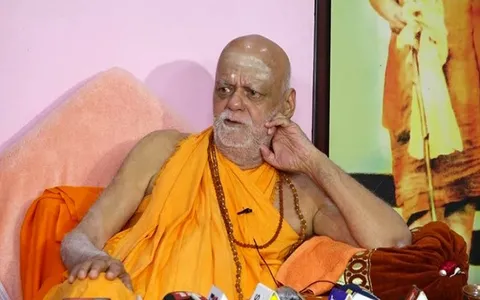
Nishchalananda Saraswati seated before a cluster of press microphones, resting his cheek on his hand as he listens
Listening to a question at a press interaction.
उपदेश

Upadeśa — personal guidance

Instruction given to individual disciples and seekers, often in reply to a specific question or difficulty. Within the tradition this is the most intimate form of teaching and the one least visible to the public.

Structure

The anatomy of a Vedantic discourse

Traditional exposition follows a recognisable shape, inherited from the commentarial method of Shankara and his successors. Knowing it helps a listener follow even a long and demanding discourse.

  1. Invocation

    Maṅgalācaraṇa — a prayer or verse honouring the teacher and the lineage, setting the frame of the teaching.

  2. The text

    Mūla — the root verse or statement from scripture, recited in Sanskrit.

  3. Exposition

    Vyākhyā — word-by-word meaning, then the sense as unfolded in the commentaries.

  4. Reasoning

    Yukti and dṛṣṭānta — arguments, objections answered, and illustrations such as the rope and the snake.

  5. Application

    How the teaching bears on conduct, society and the listener’s own inquiry.

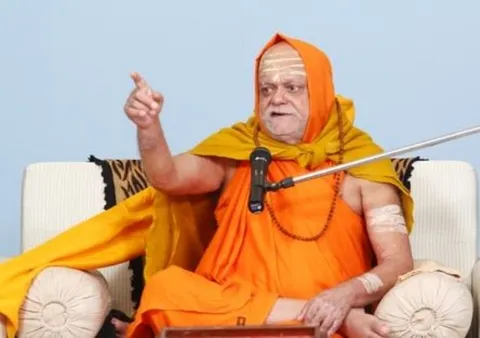
Nishchalananda Saraswati seated on a white sofa, gesturing emphatically as he explains a point into a microphone
Explaining a point during a discourse.

Listen & Watch

Where to find recorded discourses

Recordings, announcements and extracts of the Shankaracharya’s discourses are published by Govardhan Math, Puri, on its official website and social channels. Discourses are given principally in Hindi, with Sanskrit scriptural citations.

For the Listener

Listening well

The tradition asks three things of a listener: attention, patience and śraddhā — not blind belief, but the provisional trust that allows a teaching to be heard fully before it is judged. A single discourse is often one step in a longer argument, and its meaning is clearest when heard in sequence.

Newcomers may find it helpful to read the introduction to Advaita Vedanta before listening, and to consult the published works for fuller treatment of subjects touched on in speech.