Sanatana Dharma as universal principle
Dharma presented not as sectarian custom but as a coherent body of principles grounded in the Veda and reasoned through the classical philosophical schools.
Purvamnaya Sri Govardhana Peetha · Puri
145th Jagadguru Shankaracharya of the Govardhana Peetha, Puri
पूर्वाम्नाय श्री गोवर्धन पीठ
A monastic scholar of Advaita Vedanta who has presided over one of the four cardinal seats of the Shankara tradition since 1992, carrying forward a lineage devoted to the study, practice and teaching of non-dual Self-knowledge.
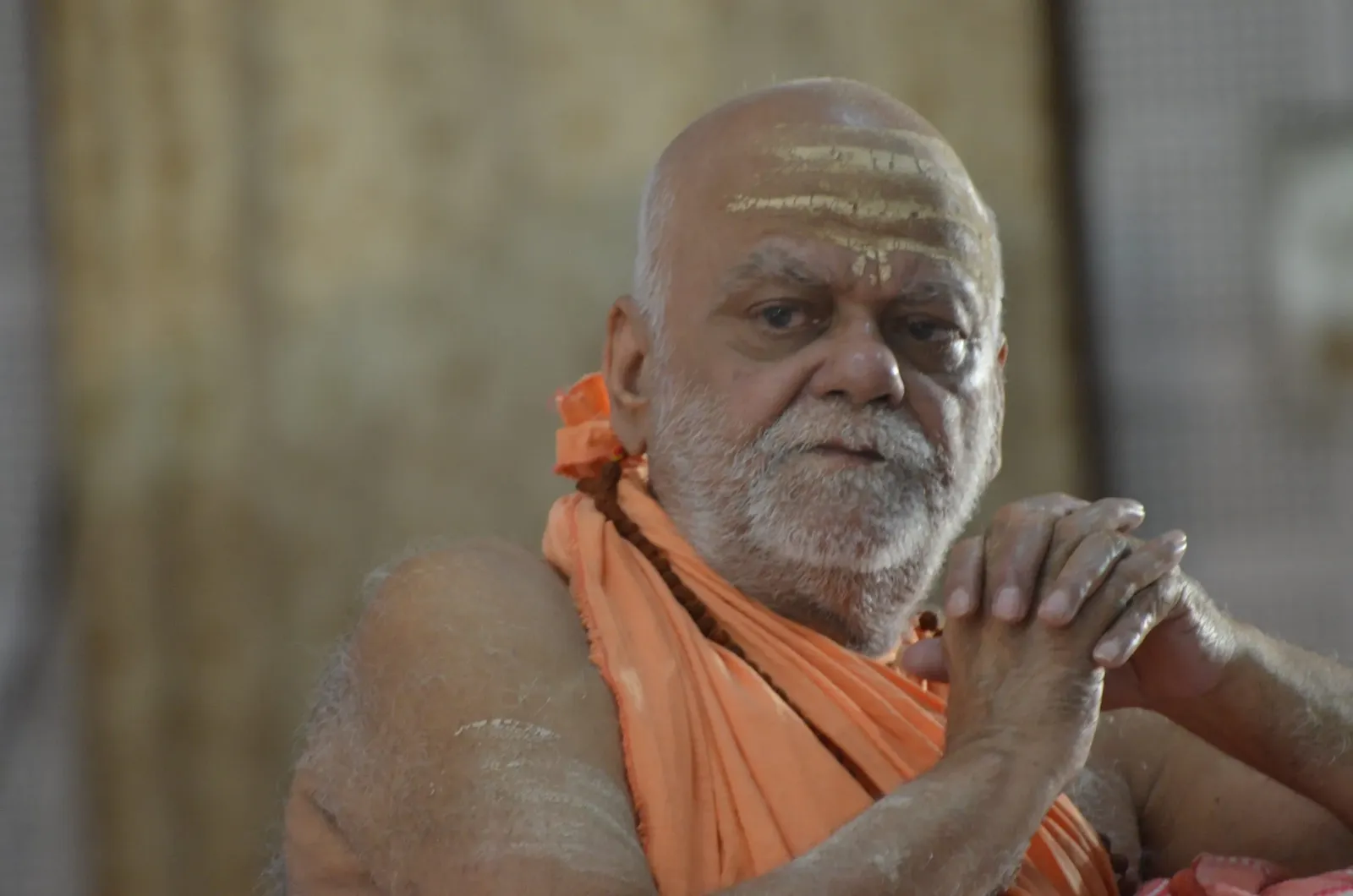
A life given to śāstra, to the discipline of renunciation, and to the living transmission of Advaita.
Introduction
Swami Nishchalananda Saraswati — often transliterated Nischalananda Saraswati — is the 145th Jagadguru Shankaracharya of the Purvamnaya Sri Govardhana Peetha in Puri, Odisha. The Peetha is one of the four principal monastic seats (maṭhas) that the Shankara tradition traces to Adi Shankaracharya, the teacher most closely identified with Advaita Vedanta, the Indian philosophy of non-duality.
Born Nilambar Jha in 1943 into a family of Sanskrit scholars in the Mithila region of Bihar, he left home as a young man to devote himself to the study of the scriptures. He trained in traditional centres of learning across India, was initiated into renunciation (sannyāsa) by Swami Karpatri in Haridwar in 1974, and later studied under his predecessor at Puri, Jagadguru Shankaracharya Swami Niranjanadeva Tirtha, who appointed him to the seat on 9 February 1992.
For more than three decades he has combined the classical responsibilities of a Shankaracharya — safeguarding a monastic lineage, teaching Vedanta and guiding householders and renunciants — with an extensive programme of writing and public discourse. His subjects range from the Upaniṣads and the Bhagavad Gītā to ethics, the mathematics of the Vedic tradition, and the place of Sanatana Dharma in contemporary life.
Dates as recorded in the biography published by Govardhan Math, Puri. Read the full biography.
The Tradition
Advaita Vedanta holds that the innermost Self of every being is not different from Brahman, the one reality underlying the universe. The Shankara tradition preserved this teaching through commentaries, monastic institutions and an unbroken practice of teacher-to-student instruction. Puri — the sacred city of Lord Jagannatha on the Bay of Bengal — has been home to its eastern seat.
Tradition & lineage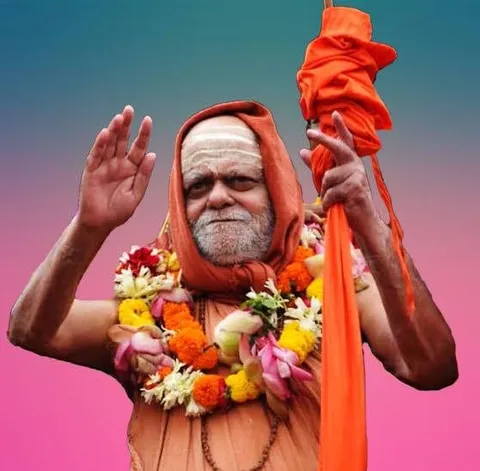
Commentator on the Upaniṣads, the Bhagavad Gītā and the Brahma Sūtras. Historians generally date him to about the eighth century CE; the maṭha traditions preserve an older chronology.
Tradition credits Shankara with four maṭhas — Sringeri, Dwarka, Jyotirmath and Puri — each linked to one Veda and one of the four great Upaniṣadic statements.
The Govardhana Peetha remembers Padmapādācārya, a direct disciple of Shankara, as its first head. Its Veda is the Ṛgveda.
A modern head of the Peetha, widely known for the posthumously published Vedic Mathematics (1965). Niranjanadeva Tirtha later led the seat from 1964 to 1992.
On 9 February 1992 Swami Nishchalananda Saraswati was appointed to the seat by his predecessor, Swami Niranjanadeva Tirtha.
Philosophical Thought
Advaita Vedanta is precise in its vocabulary. These six Sanskrit terms, explained here in plain language, form the grammar of the teaching the Govardhana Peetha exists to preserve.
The one, infinite reality — pure existence, consciousness and fullness — from which the universe appears and in which it rests.
The Self: the witnessing awareness in every person, distinct from body and mind, which Vedanta teaches is identical with Brahman.
“Not-two.” The recognition that the Self and the ultimate reality are not separate — the central claim of Shankara’s school.
The inexplicable power by which the one reality appears as many — neither absolutely real nor simply non-existent.
Knowledge — specifically, the direct understanding of one’s own nature gained through scripture, reasoning and contemplation.
Liberation: freedom from the cycle of ignorance and sorrow, understood in Advaita as the recognition of what one already is.
Govardhana Peetha
The Purvamnaya Sri Govardhana Peetha — commonly called Govardhan Math — stands in Puri, on the coast of Odisha. Pūrva means “east” and āmnāya means “sacred tradition”: the Peetha is the custodian of the eastern line of the Shankara tradition, traditionally associated with the Ṛgveda and with the mahāvākya “Prajñānaṃ Brahma” — “Consciousness is Brahman.”
Its presiding deity is Lord Jagannatha, and its goddess is Vimala, whose shrine lies within the Jagannatha temple complex. Tradition describes the whole eastern portion of the subcontinent as the Peetha’s sphere of spiritual responsibility.
Today the Peetha maintains a Vedic school, a cow sanctuary, and a family of affiliated organisations founded under the guidance of the present Shankaracharya.
History of the Peetha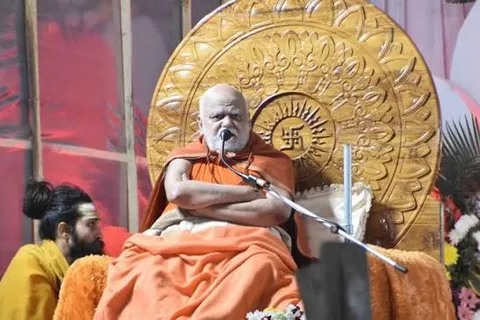
Teachings
Drawn from the Peetha’s published account of his work and from the titles of his books, these are the subjects to which the Shankaracharya returns most often.
Dharma presented not as sectarian custom but as a coherent body of principles grounded in the Veda and reasoned through the classical philosophical schools.
A long engagement with mathematics — including Sanskrit works such as Swastika Ganita and Ganitaditya — exploring how traditional learning meets modern inquiry.
A series of works on nīti — ethical and political wisdom — addressing how individuals, families and institutions ought to conduct themselves.
Addresses on the cultural and territorial integrity of India, a subject the Peetha lists prominently among the aims of his tours.
A commitment dating back to the 1966 cow-protection movement, reflected today in the Peetha’s own goshala (cow sanctuary).
Organisations for women and young people, and a stated concern for the protection of the natural environment.
Legacy & Continuity
ब्रह्म सत्यं जगन्मिथ्या
जीवो ब्रह्मैव नापरः“Brahman is real; the world is appearance; the individual self is none other than Brahman.”
A verse traditionally attributed to Adi Shankaracharya
The Shankara tradition survives because its texts are still read line by line with a teacher. The present Shankaracharya’s own formation — years devoted to the Prasthānatrayī, the Pañcadaśī and advanced dialectical works — reflects that discipline.
A maṭha is not a museum. The Govardhana Peetha operates a Vedic school, a cow sanctuary and several associated bodies — ways of translating an ancient mandate into contemporary organisation.
Through tours, discourses, press interactions and books in Hindi and Sanskrit, the Shankaracharya addresses questions of ethics, society and national life from within the frame of the śāstras.
Continue Reading
Philosophy
Brahman, Ātman, Māyā, the four great statements of the Upaniṣads and the path from inquiry to liberation.
Photographs of the Shankaracharya at assemblies, discourses and public occasions.
For correspondence regarding this website, please see the contact page. To learn more about his early life, read About.