The Eastern Seat
Purvamnaya Sri Govardhana Peetha
पूर्वाम्नाय श्री गोवर्धन पीठ · पुरी
Puri · Odisha
Bay of Bengal coast
19.8° N · 85.8° E
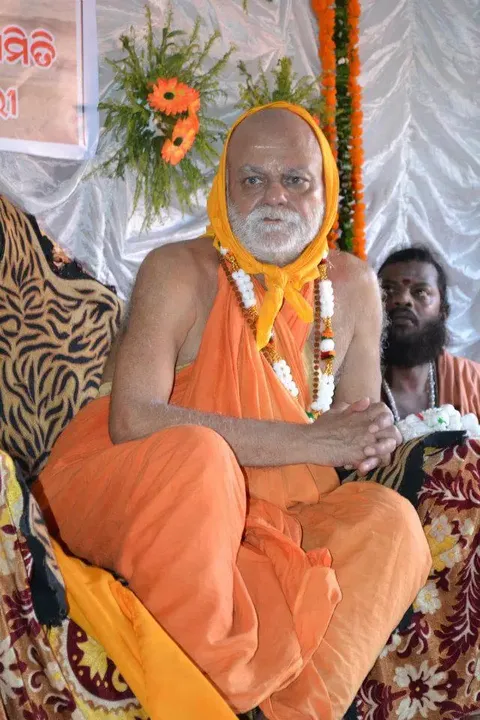
In Puri — the city of Lord Jagannatha on India’s eastern shore — stands the maṭha that the Shankara tradition regards as its eastern cardinal seat. Known popularly as Govardhan Math, it has been presided over since 1992 by Jagadguru Shankaracharya Swami Nishchalananda Saraswati.
The word Pūrvāmnāya joins pūrva, “east”, with āmnāya, “sacred tradition” or “line of transmission”. The Peetha is thus the custodian of the eastern line of Adi Shankaracharya’s teaching, one of four such lines that together are traditionally understood to span the subcontinent.
The Peetha’s official website is govardhanpeeth.org.
Historical Background
A seat in a sacred geography
Puri has been one of India’s great pilgrimage centres for many centuries. Known in Sanskrit as Puruṣottama Kṣetra, the “field of the Supreme Person”, it is counted among the four dhāmas — the four holy abodes at the cardinal points of India — and is home to the renowned temple of Lord Jagannatha.
The maṭha traditions hold that Adi Shankaracharya, in the course of travels across India, established a monastery here and installed his disciple Padmapāda as its first head. In the same way, tradition recounts, he founded seats at Sringeri, Dwarka and Jyotirmath, entrusting each to a leading disciple. The four together were meant to preserve the Vedic learning and the monastic discipline of the Advaita tradition in every direction.
The Peetha’s own chronology places its founding in remote antiquity and records an unbroken line of Shankaracharyas. Modern historians, working from textual and inscriptional evidence, generally date Adi Shankara to around the eighth century CE and trace the documented institutional history of the maṭhas over later centuries. Both perspectives are presented on this site; neither is used to make claims beyond what it supports.
| Direction | East पूर्वाम्नाय |
|---|---|
| Location | Puri, Odisha — Puruṣottama Kṣetra |
| Presiding deity | Lord Jagannatha |
| Goddess | Vimala |
| Veda | Ṛgveda |
| Mahāvākya | Prajñānaṃ Brahma — “Consciousness is Brahman” प्रज्ञानं ब्रह्म |
| First ācārya | Padmapādācārya |
| Dashanami names | Vana and Araṇya |
| Traditional sphere | The eastern regions of the subcontinent |
| Present Shankaracharya | Swami Nishchalananda Saraswati, 145th, since 1992 |
The Purvamnaya Tradition
What the eastern tradition holds in trust
The Ṛgveda. Each cardinal seat is associated with one of the four Vedas. The Govardhana Peetha’s Veda is the Ṛgveda, the oldest of the four, and its mahāvākya comes from the Aitareya Upaniṣad, which belongs to the Ṛgvedic literature. The statement Prajñānaṃ Brahma (Aitareya Upaniṣad 3.3) declares that the consciousness by which everything is known is itself Brahman, the ultimate reality.
Padmapāda’s legacy. Padmapāda, remembered as the Peetha’s first ācārya, is traditionally regarded as one of Shankara’s foremost disciples. He is credited with the Pañcapādikā, a sub-commentary on Shankara’s commentary on the Brahma Sūtras. Its later elaboration gave rise to the Vivaraṇa school, one of the two main interpretive currents within Advaita Vedanta.
The Dashanami names. Renunciants of the Shankara order take one of ten names (the Daśanāmī), each associated with a particular seat. Those traditionally linked to the Govardhana Peetha are Vana (“forest”) and Araṇya (“wilderness”) — names that recall the forest hermitages where the Upaniṣadic teachings were first taught.
Jagannatha and Vimala. Each seat is also linked with a presiding deity and goddess. At Puri these are Lord Jagannatha and the goddess Vimala, whose shrine stands within the precincts of the Jagannatha temple. The association reflects how the Shankara tradition integrated the teaching of non-duality with the living temple worship of the places where its seats were founded.
Role & Significance
A monastery, a school and a voice of the tradition
A cardinal maṭha serves several purposes at once. It is a monastic home where the discipline of renunciation is lived and transmitted. It is a place of learning, where the Vedas, the Upaniṣads and the classical commentaries are studied. And it is a public institution, whose head is consulted by followers on questions of dharma and whose pronouncements carry the weight of a long tradition.
Because the four seats are regarded as complementary rather than competing, each Shankaracharya speaks from within a shared inheritance while carrying responsibility for a particular region and line of transmission.
Recent Succession at Puri
- 1925 – 1960
Swami Bharati Krishna Tirtha
A scholar with a modern university education, widely known for Vedic Mathematics, published posthumously in 1965.
- 1960 – 1961
Swami Yogeshwarananda Tirtha
Succeeded Bharati Krishna Tirtha; his tenure ended with his passing in 1961.
- 1964 – 1992
Swami Niranjanadeva Tirtha
Installed in 1964. He taught the present Shankaracharya for several years and appointed him as his successor in 1992.
- 1992 – present
Swami Nishchalananda Saraswati
The 145th Jagadguru Shankaracharya, appointed on 9 February 1992.
Tenure dates follow the Govardhan Math entry in standard reference sources. For the wider succession tradition, see Tradition & Lineage.
Institutions Today
The Peetha’s living work
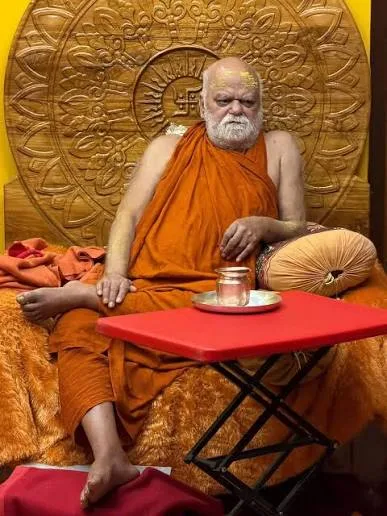
Alongside its monastic and scholarly life, the Peetha lists a number of institutions and associated organisations on its official website. Several were established under the guidance of the present Shankaracharya through the Peetha Parishad; others continue movements associated with his guru, Swami Karpatri. Their stated aims are summarised below.
- Ved Gurukulam
- A school for the traditional study of the Vedas.
- Shree Govardhan Goshala
- The Peetha’s sanctuary for the care of cows.
- Peetha Parishad
- Operates educational and scientific institutions in the Vedic manner, towards the four aims of life (puruṣārthas).
- Aditya Vahini
- An organisation for men and boys, founded to cultivate fearlessness, good conduct and service.
- Ananda Vahini
- An organisation for women and girls, aiming at well-educated, well-cultured families and society.
- Sanatana Sant Samiti
- Presents Vedic philosophy on philosophical, scientific and practical grounds.
- Rashtrotkarsh Abhiyan
- A campaign for national upliftment through agriculture, cow protection, commerce and cottage industries.
- Hindu Rashtra Sangh
- Stated aim: to protect the existence and values of Hindus, with due regard to the welfare of others.
- Dharma Sangh
- Seeks dedication to Sanatana Dharma and governance guided by dharmic principles.
- Ramrajya Parishad
- Advocates governance within the contours of dharma, free of bias and exploitation.
A note on sources
Descriptions of the Peetha’s institutions paraphrase the Peetha’s own published statements. Historical dates follow standard reference works, and traditional chronology is identified as such. Readers seeking authoritative institutional information should consult Govardhan Math, Puri directly.